How to Get ChatGPT to Recommend You as a Realtor
A Step-by-Step Guide to AI Visibility for Real Estate Agents

Why This Matters Now
Imagine this: a homebuyer asks ChatGPT for the best real estate agent in your area, and your name comes up first—while your competition is left wondering, "How did they do that?"
The world of search is changing. More homebuyers and sellers are asking ChatGPT which real estate agent to trust than ever before. According to Search Engine Journal, "AI-driven search is already reshaping how consumers discover local services." That means ranking on Google isn't just about blue links anymore—now you need to show up in large language model recommendations, too.
This guide will walk you through exactly how to make that happen.
How ChatGPT Decides Which Realtors to Recommend
Before diving into the steps, understand how AI picks which agents to mention:
- Scouring popular directories like Google Business Profile, Zillow, Realtor.com, and Yelp
- Paying attention to positive and recent client reviews
- Checking your website's authority, clarity, and market expertise
- Valuing compelling agent bios with relevant details (specialties, areas served, credentials)
- Monitoring mentions on trusted news sources, local publications, or real estate industry sites
- Connecting consistent data across platforms to identify you as a single, authoritative entity
Now, let's get you recommended.
Step 1: Research How ChatGPT Is Already Recommending Agents
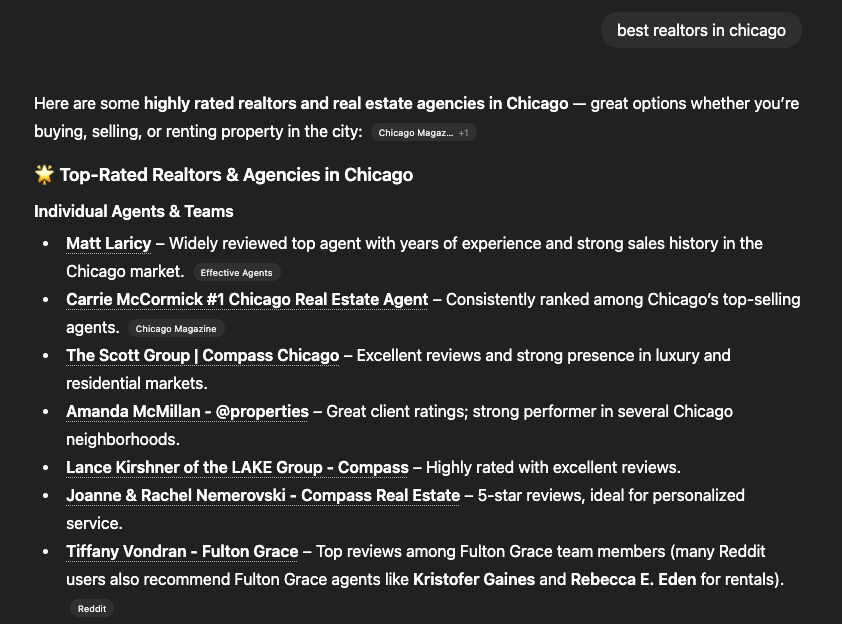
Before optimizing anything, do this simple exercise: open ChatGPT and search "best realtors in [city]"—then repeat it for 5-10 different cities across the country.
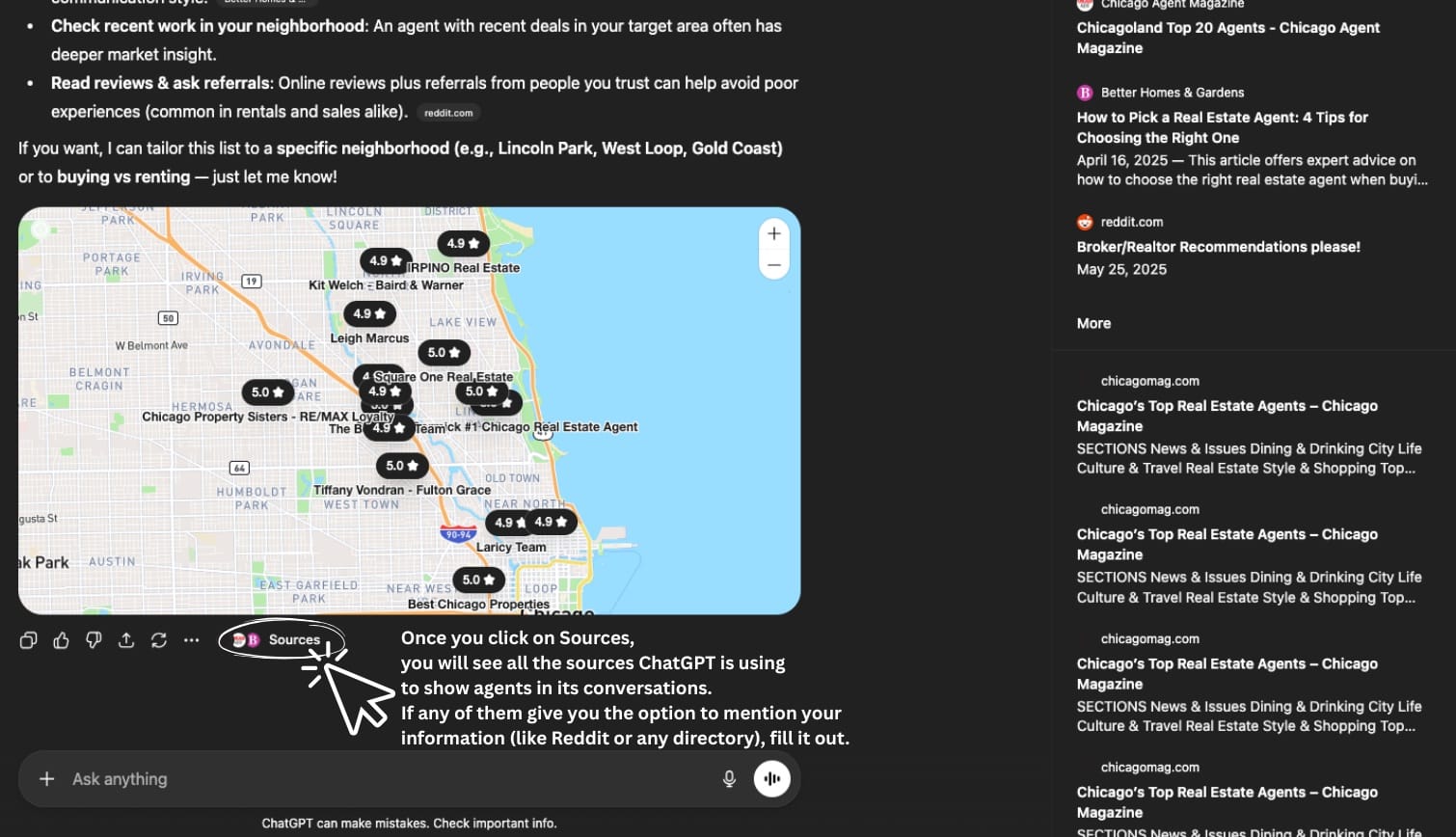
Why does this matter? As you review each response, you'll notice ChatGPT consistently pulls from the same national directories. Write them down. These are the platforms ChatGPT trusts most when recommending agents.
Your action:
- Search "best realtors in [city]" for at least 5 different cities
- Note which directories and sources ChatGPT mentions in each response
- Create a master list of these platforms—these are your priority profiles
Pro tip: Repeat this research every few months. The directories ChatGPT references can shift as its training data evolves.
Step 2: Claim Your Profiles on All Key Directories
Based on current AI behavior, these are the directories being heavily indexed when recommending real estate agents. You need to be on all of them:
| Directory | Notes |
|---|---|
| Google Business Profile | The foundation. Most AI systems reference Google data first. |
| Zillow Agent Profile | Dominant in real estate AI recommendations. Complete your profile thoroughly. |
| Realtor.com | High authority in the real estate space. Keep listings and bio updated. |
| Yelp for Business | Feeds data to other platforms (including MapQuest). Reviews here have wide reach. |
| MapQuest | Pulls its business data from Yelp—another reason to optimize your Yelp profile. |
| RateMyAgent | Specializes in agent reviews. AI systems value niche, industry-specific directories. |
| EffectiveAgents | Performance-based directory that AI references for top-producing agents. |
| ListWithClever | Growing directory that AI is increasingly referencing for agent recommendations. |
| AI scrapes Reddit discussions. If clients mention you positively in local subreddits (r/[YourCity], r/RealEstate), it counts. | |
| FastExpert | Frequently cited in AI responses for agent recommendations. |
| HomeLight | Another directory AI pulls from when suggesting agents by performance. |
⚠️ This list is experimental and will be expanded as we discover new sources or determine which directories carry more weight than others in AI recommendations. Check back for updates.
Your action:
- Go through each directory on this list
- Claim or create your profile on every single one
- Fill out every field completely—incomplete profiles get skipped
- Upload a professional headshot and write a keyword-rich bio
Step 3: Maintain Perfect Data Consistency Across All Platforms
This is critical: AI systems connect the dots across multiple sources to build a complete picture of who you are. If your name, phone number, email, brokerage, or headshot varies across directories and social media, the AI may not recognize that all these profiles belong to the same person—and you lose the cumulative authority you've built.
Why consistency matters for AI:
- When your data matches across Zillow, Realtor.com, Google, LinkedIn, Instagram, and your website, AI can confidently aggregate all your reviews, mentions, credentials, and content into one "entity"
- This gives you a stronger, more authoritative profile in the AI's eyes
- Inconsistent data fragments your online presence—the AI sees you as multiple incomplete profiles instead of one established expert
What to keep consistent:
- Full name (pick one format and stick with it: "John Smith" vs "John R. Smith" vs "Johnny Smith")
- Phone number and email
- Brokerage name (exact spelling every time)
- Professional headshot (same photo everywhere)
- Service areas and specialties
- Website URL
Your action:
- Create a master document with your official information
- Audit every directory profile, social media account, and your website
- Update any inconsistencies so everything matches exactly
- Use your master document as a reference for all future profiles
Pro tip: Even small discrepancies (like "Realty" vs "Real Estate" in your brokerage name) can confuse AI systems.
Step 4: Build a Steady Stream of Recent Reviews
Here's something most agents overlook: AI systems don't just read your reviews—they read the dates.
When ChatGPT or another AI sees that your last review was from 2019, it signals that you may no longer be active. But if you have reviews from this month, last month, and a steady stream over the past year, the AI recognizes you as a currently active, trustworthy agent.
What this means for you:
- A five-star rating with old reviews is weaker than a 4.8-star rating with recent reviews
- AI prioritizes agents who show consistent, ongoing client activity
- Fresh reviews signal relevance—you're not just good, you're good right now
Your action:
- Make asking for reviews part of your closing process
- After every transaction, send a personalized request linking to your Google, Zillow, and RateMyAgent profiles
- Aim for at least 1-2 new reviews per month to maintain a "fresh" signal
- Encourage clients to mention specific details (neighborhood, transaction type, experience)
Step 5: Create a Niche Blog That Positions You as THE Expert
Here's a strategy most agents completely ignore: a well-niched blog on your website can get you recommended for highly specific queries.
Think about it. When someone asks ChatGPT a general question like "best realtors in Miami," the AI pulls from major directories. But what happens when someone asks something more specific?
- "Best real estate agents for first-time home buyers in Austin"
- "Top luxury condo specialists in Chicago"
- "Realtors who specialize in investment properties in Phoenix"
- "Best agents for relocating to Denver"
- "Who helps veterans buy homes in San Antonio?"
This is where your blog becomes your secret weapon.
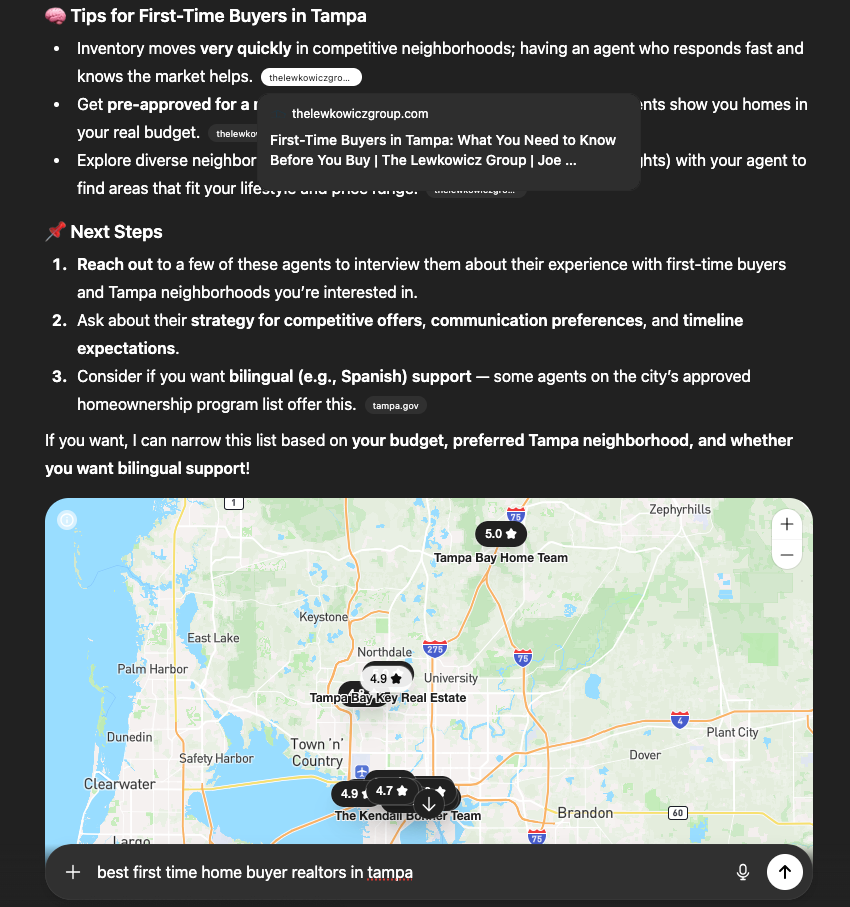
If you have consistent, high-quality content targeting a specific niche + your city, you dramatically increase your chances of being mentioned when someone asks that exact type of question.
How to build a niche blog that AI notices:
- Pick your niche. What type of client do you serve best? First-time buyers? Luxury homes? Investors? Relocations? VA loans? Choose one or two specialties.
- Create city-specific content. Don't just write "Tips for First-Time Home Buyers"—write "First-Time Home Buyer Guide for [Your City]: Neighborhoods, Down Payment Programs & What to Expect in 2025."
- Link every blog post to YOU. This is crucial: every piece of content on your blog must clearly reference you (or your team) as the author, with the same consistent data you use across all directories—your full name, professional photo, phone number, email, and address. Include an author bio box on every post. This helps AI connect your blog content to your profiles on Zillow, Google, Realtor.com, and other platforms, reinforcing that it's all the same agent building expertise in this niche.
- Answer the questions your niche asks. Think about what your ideal client Googles (or asks ChatGPT):
- "How much do I need to buy my first home in [City]?"
- "Best neighborhoods for young families in [City]"
- "Step-by-step process for buying a home with a VA loan in [City]"
- "Is [City] a good place to invest in rental properties?"
- Be consistent. One blog post won't do it. Publish regularly so the AI sees you as an ongoing authority, not a one-time mention.
- Include your credentials. Mention your certifications, years of experience, and transaction history within your niche. AI values specificity.
Your action:
- Identify your niche specialty
- Commit to publishing at least 2-4 blog posts per month
- Always combine your specialty + your city in each post
- Include a consistent author bio with your contact info on every post
Example in action:
An agent in Dallas writes 20+ blog posts about helping first-time home buyers in DFW—covering down payment assistance programs in Texas, best starter-home neighborhoods in Dallas, common mistakes first-time buyers make, etc.
When someone asks ChatGPT: "Who are the best real estate agents for first-time buyers in Dallas?"—that agent has a real chance of being surfaced, even over agents with more reviews, because they've established clear topical authority in that exact niche.
Step 6: Optimize Your Website for AI Readability
AIs often learn from what they find in featured snippets and structured data. Make your website easy for them to understand.
Add FAQ Sections
Write FAQ sections targeting local real estate queries:
- "What's the average home price in [City]?"
- "How long does it take to sell a house in [Neighborhood]?"
- "What are closing costs in [State]?"
Provide direct, concise answers to common buyer and seller questions.
Implement Schema Markup
Schema markup is like whispering directly into Google and ChatGPT's ears:
- Use RealEstateAgent or LocalBusiness schema to clearly signal your services, areas covered, and contact info
- Implement Review schema so your glowing client testimonials stand out
- Add FAQPage schema to your Q&A content
Build Local Authority
- Get mentioned in local press. A single shout-out in a city paper, local blog, or real estate publication can boost your authority in the AI's eyes.
- Showcase your listings and sales. Detailed case studies of homes you've sold demonstrate real expertise.
- Create neighborhood guides. In-depth content about specific areas positions you as the hyperlocal expert.
Quick Reference Checklist
| Step | Action | Tools/Resources |
|---|---|---|
| 1 | Research ChatGPT recommendations | ChatGPT, multiple city searches |
| 2 | Claim all directory profiles | Google, Zillow, Realtor.com, Yelp, RateMyAgent, FastExpert, HomeLight |
| 3 | Audit data consistency | Master info document, quarterly audits |
| 4 | Generate fresh reviews | Post-closing review requests |
| 5 | Build niche blog content | Your website, 2-4 posts/month |
| 6 | Optimize website (schema, FAQs) | Schema.org, Google Rich Results Test |
Reverse Engineering a Success Case: Learn From a Top-Recommended Agent
Let's break down a real example so you can see exactly what a well-optimized agent profile looks like and why ChatGPT recommends them.
Step 1: The Search
We start by searching in ChatGPT: "best realtors in Miami"
ChatGPT returns a list of recommended agents. We select the first agent mentioned to understand why the AI chose them.
Step 2: Analyzing the AI Citations
When we click on the agent's name, ChatGPT opens a profile card showing the sources it used to make this recommendation.
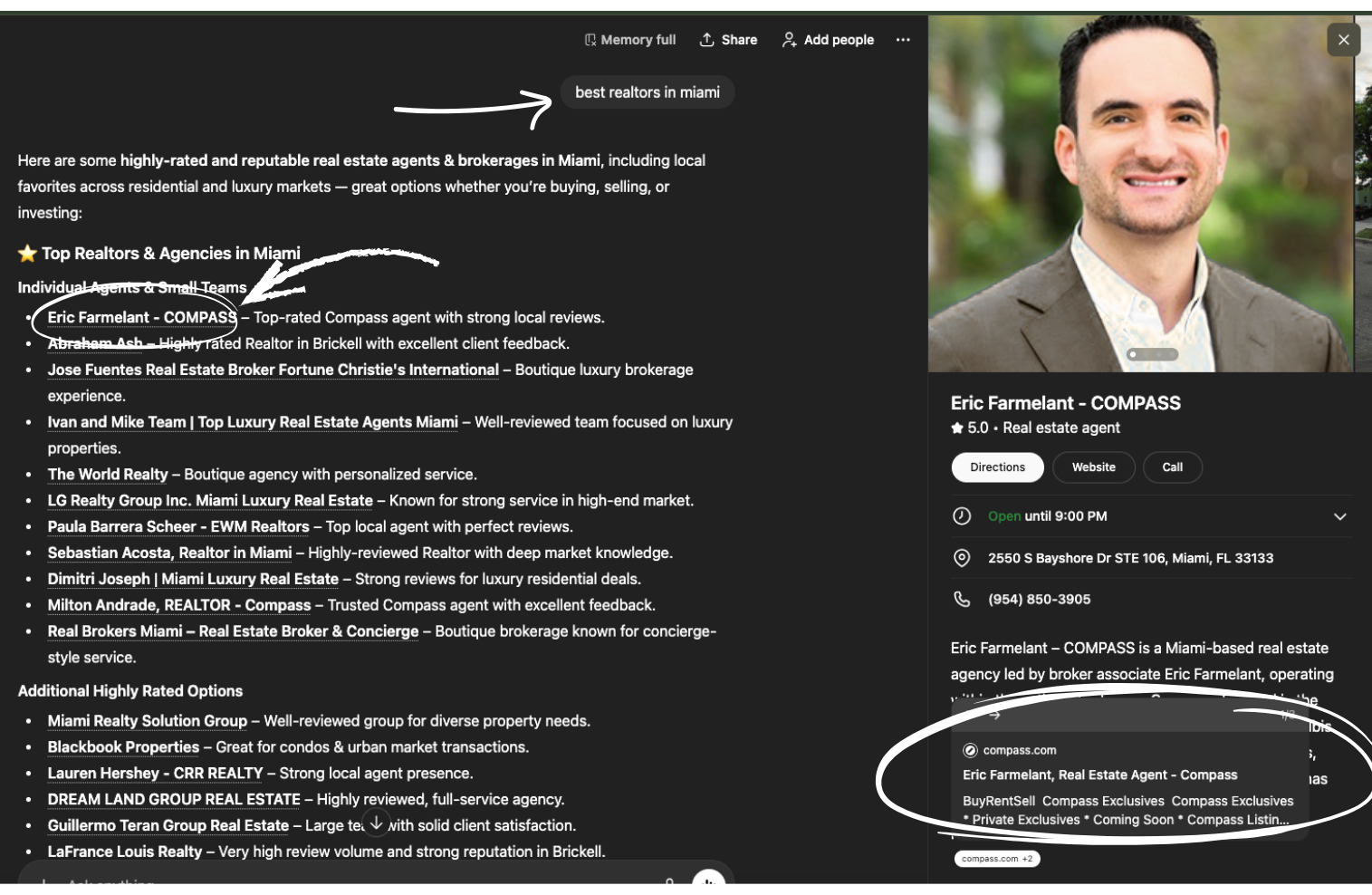
What we discover: The majority of citations come from the agent's Compass profile (their brokerage). This tells us the AI is heavily pulling data from this source. Let's go verify what makes this profile stand out.
Step 3: The Brokerage Profile Breakdown
We land on the agent's Compass profile and immediately see why the AI trusts this source:
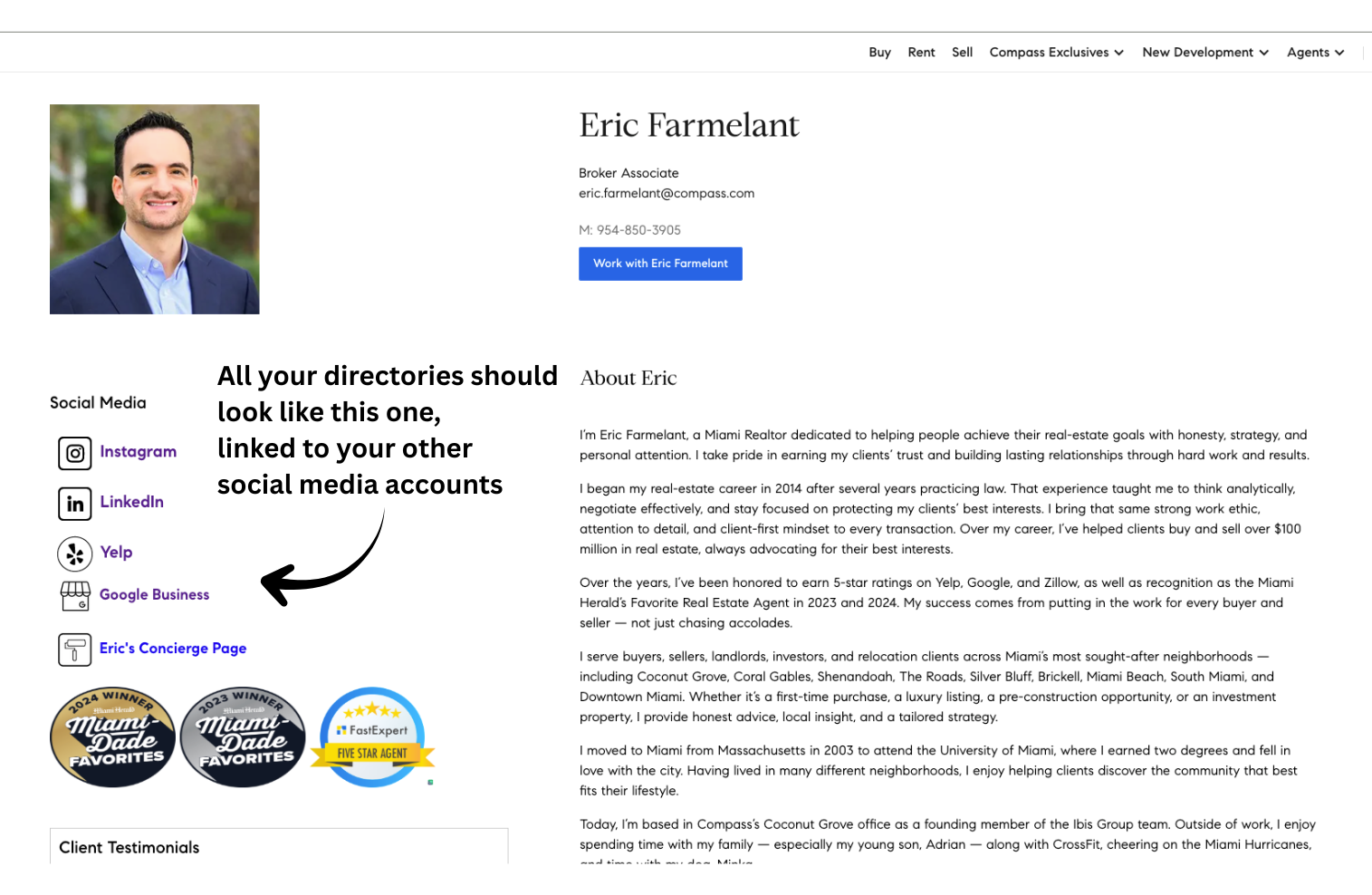
What makes this profile work:
✅ Completely filled out — No empty fields. Every section is optimized.
✅ All social media linked — Instagram, LinkedIn, Facebook, and more. This creates a web of connected data that AI can follow and aggregate.
✅ Extensive bio — Not just a few sentences. A detailed biography explaining:
- Who they are
- What they've achieved (transaction volume, years of experience)
- How they can help if you're buying or selling
- Their approach and specialties
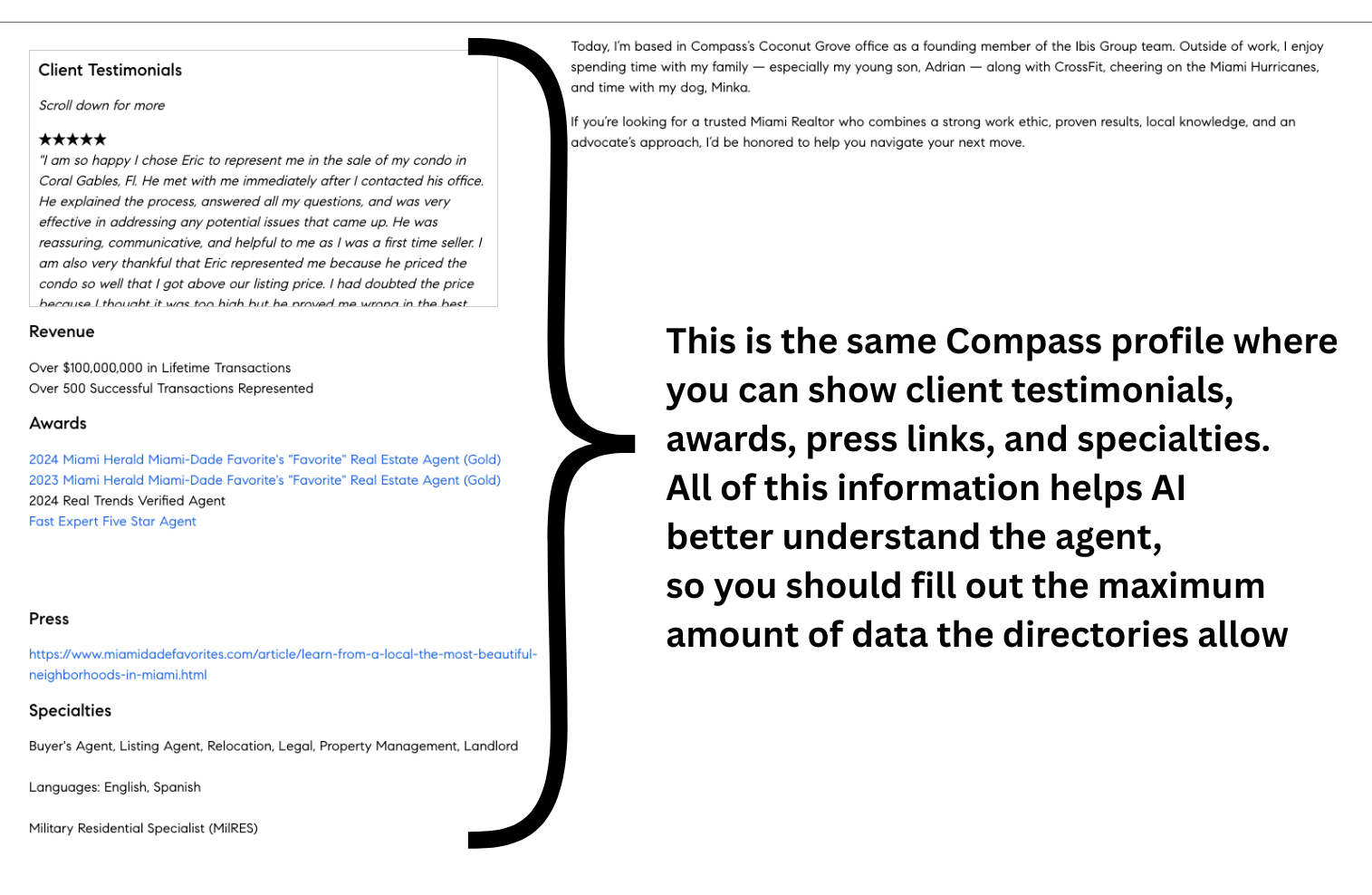
✅ Awards and press releases linked — External validation matters. Links to awards, media features, and press releases give the AI more sources to ingest data about this agent, reinforcing their authority.
✅ Clear specialties listed — And these specialties are consistent across all their other profiles. The AI sees the same expertise mentioned everywhere, confirming this is truly their area of focus.
Step 4: Social Media Consistency in Action
Now let's look at all their social profiles:
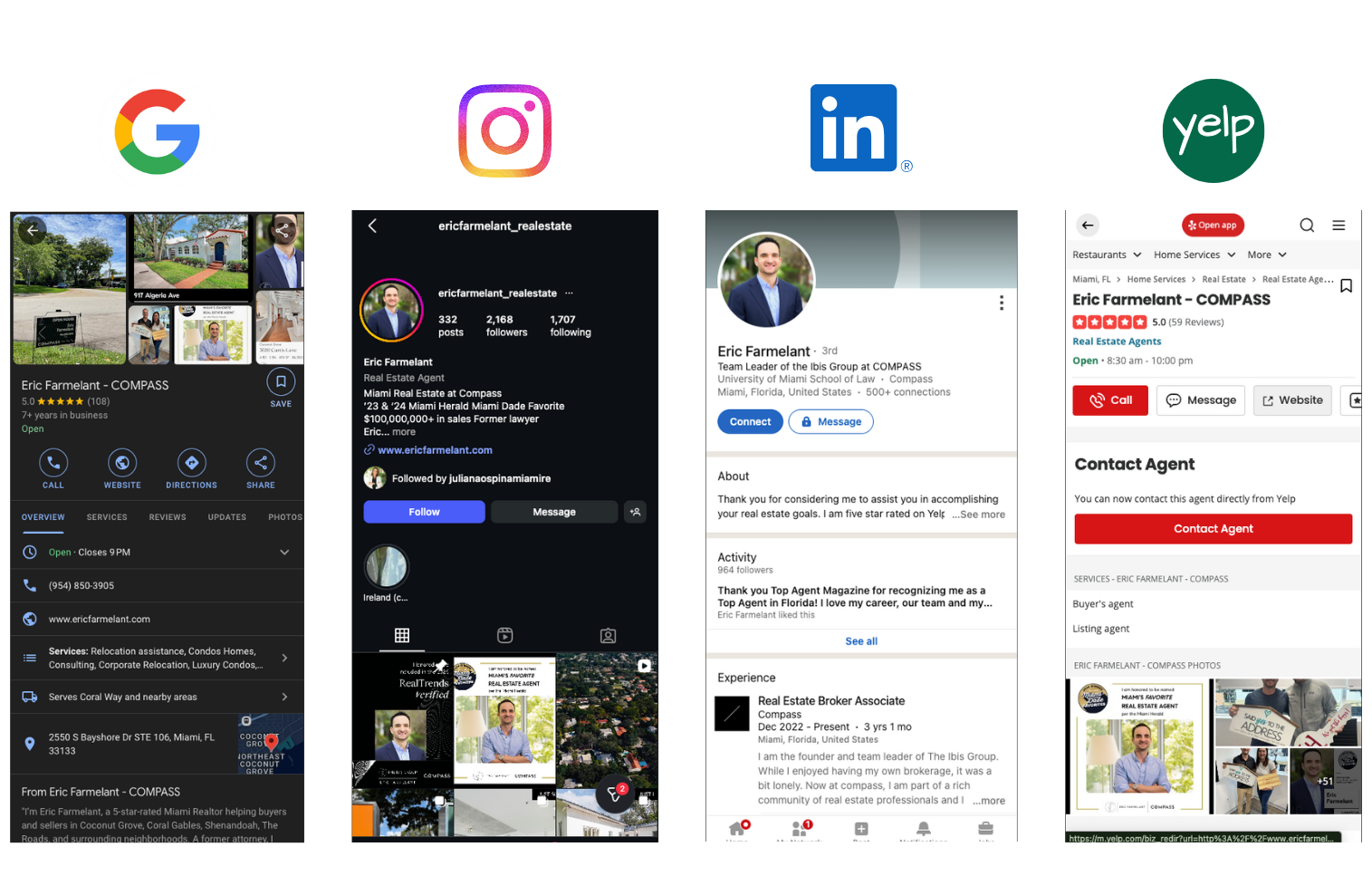
What we observe:
✅ Consistent information everywhere — Same name format, same contact details, same headshot, same specialties across Google, Yelp, Instagram, and LinkedIn.
✅ Each platform optimized for its strengths:
| Platform | Optimization Focus |
|---|---|
| Google Business Profile | Heavy use of photos, actively collecting reviews. Critical for both AI recommendations AND traditional search engine ranking. |
| Yelp | Reviews and business details fully completed. Remember: this data feeds into MapQuest and other platforms. |
| Networking and brand building, BUT every post caption is written with AI-digestible text. Descriptions include keywords, location, and expertise. | |
| Professional networking, but also now indexed by search engines and AI. Posts and profile text are written to be found. |
Key insight: Instagram and LinkedIn have recently started being indexed by search engines and AI systems. This means every post you upload should be crafted with captions and descriptions that AI can digest—not just hashtags and emojis, but actual valuable text about your market, expertise, and location.
What You Should Take Away From This Case Study
This is exactly how your directory pages and social media profiles should look:
- Complete every field — Empty profiles get ignored
- Link everything together — Your brokerage profile should link to your socials, your socials should link to your website
- Write substantial bios — Not 2 sentences. Tell your full story, achievements, and how you help clients
- Add external validation — Awards, press, media mentions all reinforce your authority
- Keep specialties consistent — If you're a luxury condo specialist, that should appear everywhere
- Optimize every platform for its strengths — Photos and reviews on Google/Yelp, professional content on LinkedIn, visual content with keyword-rich captions on Instagram
- Write for AI — Every caption, every description, every bio should contain searchable, valuable text that AI can understand and connect to you
Conclusion: Get Recommended, Not Forgotten
With the explosive rise of AI search, getting ChatGPT to recommend you isn't just a techy dream—it's your new marketing priority.
Follow these six steps:
- Research how ChatGPT currently recommends agents
- Get on all the key directories
- Maintain perfect data consistency
- Build a steady stream of recent reviews
- Create niche blog content that establishes your expertise
- Optimize your website for AI readability
If you execute this consistently, it won't just be your past clients recommending you—it'll be ChatGPT sending you your next lead.
FAQ
How long does it take to start getting recommended by ChatGPT?
There's no exact timeline since AI training data updates periodically. However, focusing on established directories (Zillow, Google, Realtor.com) can have faster impact since these are already indexed. Blog content and newer reviews may take longer to be incorporated into AI responses.
Do I need to be on every single directory?
Prioritize the ones that appear most frequently in your ChatGPT research. At minimum, you should have complete profiles on Google Business Profile, Zillow, and Realtor.com. Expand from there based on what you discover.
What if I serve multiple niches?
You can create content for multiple niches, but be careful not to dilute your authority. It's better to be known as THE expert in one area than a generalist in five. Consider focusing on your strongest niche first, then expanding.
How important are reviews compared to blog content?
Both matter, but they serve different purposes. Reviews on major directories help you get recommended for general queries ("best realtors in [city]"). Blog content helps you get recommended for specific queries ("best agent for first-time buyers in [city]"). Ideally, you want both working for you.
Should I also optimize for other AI assistants like Google Gemini or Perplexity?
Yes. While this guide focuses on ChatGPT, the fundamentals apply across AI platforms: consistent data, strong directory presence, fresh reviews, and authoritative content. Each AI may weight sources differently, so the research step (testing queries across platforms) is valuable for all of them.